Concrete Sleeper vs Timber Retaining Walls: Which Is Better?
The best retaining wall for your Melbourne property depends on your budget, site conditions and long-term plans. Concrete sleepers are a strong option if you want a durable, low-maintenance solution that resists rot and termite damage. Timber sleepers, on the other hand, are often more affordable upfront and offer a natural look that suits garden landscaping, particularly for suitable low retaining walls.
Timber retaining walls remain a popular choice for residential gardens because treated pine sleepers are generally affordable, easy to work with and blend naturally into outdoor spaces. However, their durability depends on the timber species, preservative treatment, moisture exposure and installation quality.
Concrete sleeper retaining walls are worth considering for projects where long-term durability, reduced material maintenance and a modern finish are priorities. They can also be suitable for taller walls or areas near driveways and boundaries, provided the complete wall system is correctly designed for the soil conditions and additional loads.
Neither material is automatically the better choice. Before deciding, consider the wall height, soil stability, drainage, nearby structures and any engineering or council approval requirements that apply to your property.
Concrete vs Timber Retaining Walls at a Glance
| Factor | Concrete sleepers | Timber sleepers |
|---|---|---|
| Upfront cost | Higher upfront cost than treated pine | Lower upfront cost |
| Durability | Concrete doesn’t rot and isn’t eaten by termites | Timber eventually decays, especially in wet ground |
| Appearance | Available in a range of finishes, including smooth, rockface, block-look and woodgrain | Natural appearance that suits many gardens |
| Access | Sleepers are heavy, so machinery is often needed to place them, which can be an issue on tight-access sites | Light and easy to cut, so it suits tight access and curved or stepped layouts |
| Typical use | Systems can be designed for taller walls when the posts and footings are engineered to suit | Less suitable for higher, structural or boundary walls unless specified for it |
Concrete Sleeper Retaining Walls
A concrete sleeper retaining wall uses reinforced concrete panels slotted between steel posts set in concrete footings. The posts carry most of the load, and the sleepers span between them to hold back the soil.
Typical posts are galvanised steel H-sections between sleepers and C-sections at the ends. They’re hot-dip galvanised for corrosion protection and designed to be concreted into the ground.
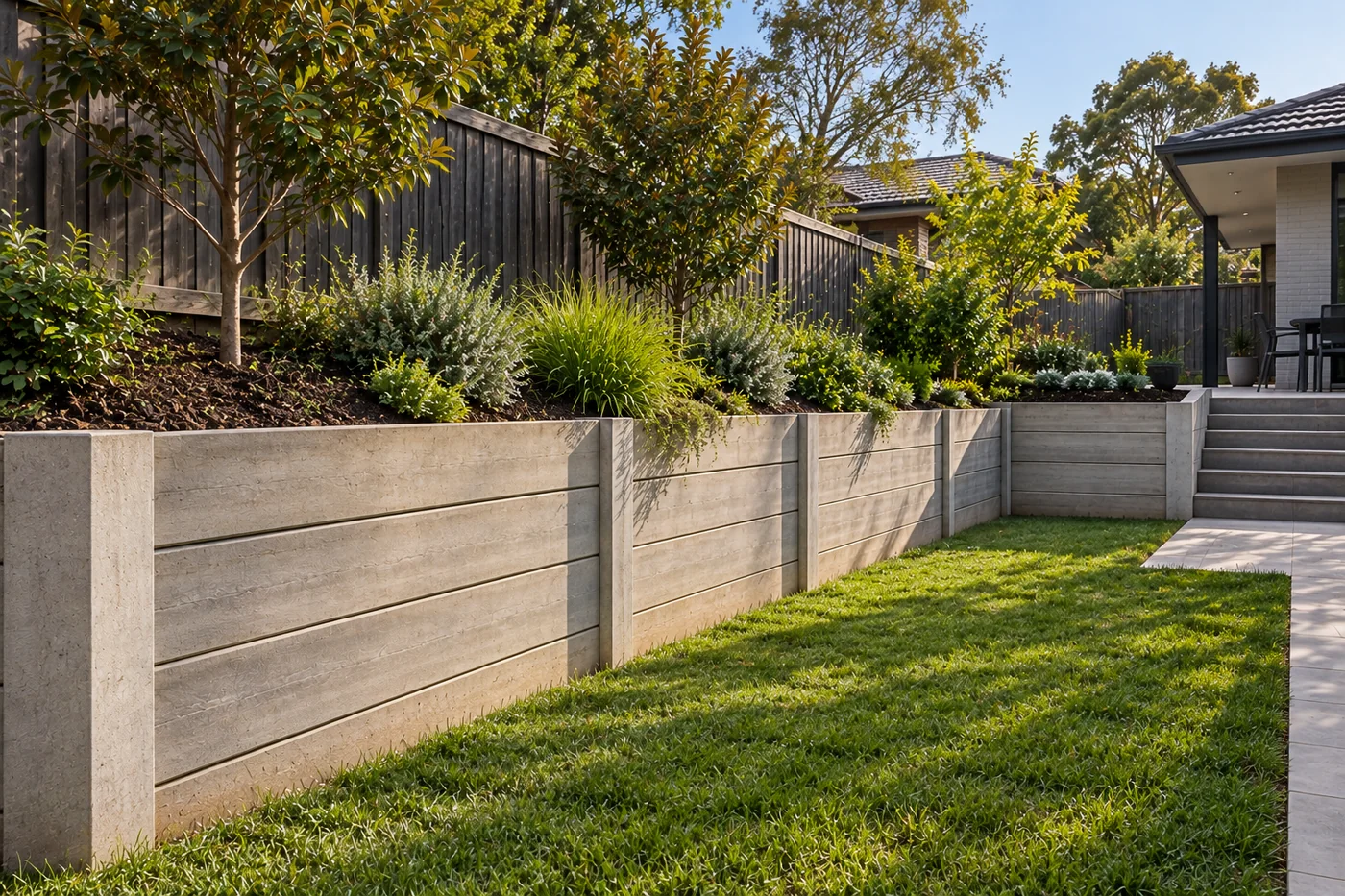
- Concrete doesn’t rot and isn’t eaten by termites
- Available in a range of finishes, including smooth, rockface, block-look and woodgrain
- Systems can be designed for taller walls when the posts and footings are engineered to suit
- Higher upfront cost than treated pine
- Sleepers are heavy, so machinery is often needed to place them, which can be an issue on tight-access sites
- The steel posts still need correct galvanising and drainage to perform long term
Timber Sleeper Retaining Walls
Timber sleeper walls are built from preservative-treated pine or hardwood sleepers, held by timber or steel posts set in the ground. They’re the traditional choice for garden walls and raised beds in Australia.
Treated pine is graded by hazard class, which tells you the level of exposure it’s treated for.
- H4: used for general retaining applications, such as low walls under 1 m high.
- H5: recommended where sleepers are in contact with groundwater, for walls higher than 1 m, or for other more critical applications.
Not all treated pine is structural. Standard H4 200 × 75 sleepers are generally sold as a garden-grade, non-structural product. If the wall matters structurally, confirm the product is suitable before it’s specified.
Hardwood sleepers are heavier and can look more natural or rustic. Their durability depends on the species and how they’re used in the ground, so check the supplier’s durability information before choosing.
Timber walls don’t have to use timber posts. Some galvanised steel post systems are designed to take either timber or concrete sleepers. This combines a natural timber face with posts that won’t rot.
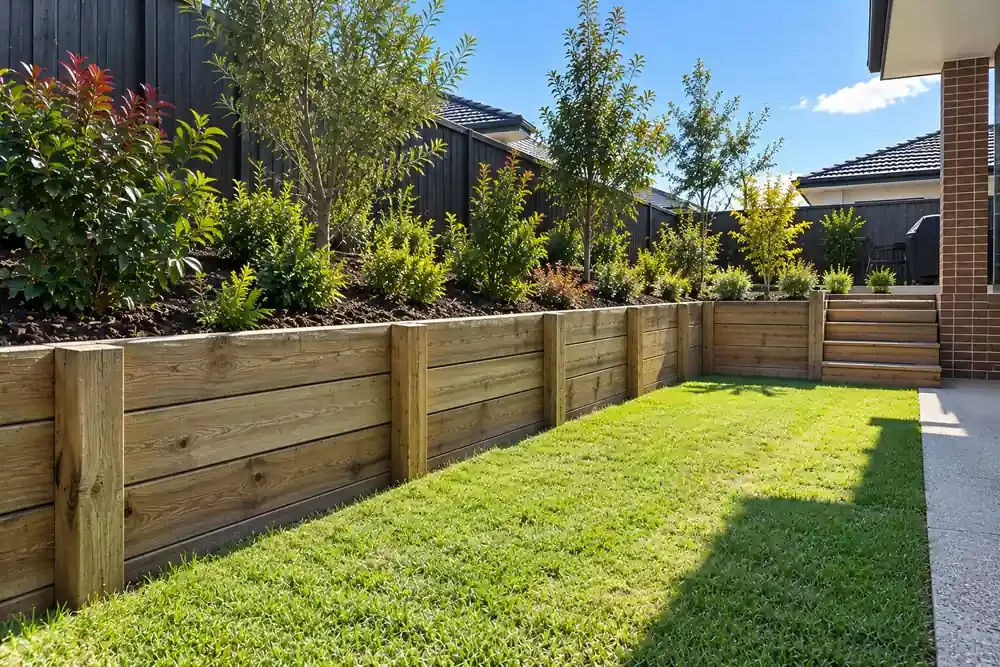
- Lower upfront cost
- Light and easy to cut, so it suits tight access and curved or stepped layouts
- Natural appearance that suits many gardens
- Timber eventually decays, especially in wet ground
- Durability depends heavily on treatment level and how cut ends are sealed
- Less suitable for higher, structural or boundary walls unless specified for it
Retaining Wall Cost
Published Melbourne cost guides put installed prices at roughly:
| Wall type | Indicative installed cost | Rough service life |
|---|---|---|
| 10 m treated pine sleeper wall, about 1 m high, good access | $2,100–$4,700 | 15–25 years |
| 10 m concrete sleeper wall, about 1 m high, good access | $2,600–$6,300 | 50+ years |
These are indicative guides, not quotes. Your actual price depends on the site.
Timber is usually cheaper to install, but a cheaper wall that needs replacing sooner can cost more over time. One way to compare is cost per year of expected service: divide the installed price by the number of years you’d realistically expect the wall to last on your site. Get that service-life estimate from your installer, based on the actual product and conditions, rather than a generic figure.
Drainage is a cost for either material. Melbourne guides put drainage behind a wall at around $32–$84 per lineal metre. It’s not optional on either material.
Your actual price depends on:
- Wall length and height
- Site access, and whether machinery can get in
- Excavation and removal of soil
- Footings and post size
- Drainage behind the wall
- Removal of an old wall
- Engineering and permit costs, where needed
- Finishes such as capping, steps and surrounding landscaping
Retaining Wall Lifespan and Durability
Cost guides often quote around 15–25 years for timber sleeper walls and 50+ years for concrete sleeper walls. Treat these as rough industry estimates, not guarantees. The real service life depends on:
- For timber: hazard class, timber species, whether cut ends were resealed, soil moisture and drainage
- For concrete: sleeper quality, the corrosion protection on the steel posts, footing depth and drainage
- For both: how well the wall was designed and built for the load it’s holding
Material durability and wall durability aren’t the same thing. A concrete sleeper wall with undersized posts or no drainage can still lean or fail, while a correctly specified timber wall in dry ground can perform well for many years.
Strength, Load and Engineering
The strength of a retaining wall comes from the whole system, not just the sleepers. What matters is:
- Retained height: taller walls hold back more soil and much higher pressure
- Soil type: clay and sandy soils load a wall differently
- Water pressure: water trapped behind a wall adds significant load
- Surcharge loads: driveways, cars, buildings, pools or fill near the top of the wall add extra pressure
- Post size, spacing and footing depth: these are what actually resist the load
With the right posts and footings, concrete sleeper systems can be engineered for considerably taller walls. Timber is generally used for lower walls.
When to get engineering advice: walls over 1 m, walls near driveways, buildings or boundaries, walls supporting other structures, and any wall where failure could damage property or injure someone.
Retaining Wall Maintenance
Neither material is maintenance-free.
- Look for leaning, bulging or cracking
- Make sure drainage outlets and weep points are clear
- Keep surface water from pooling at the top of the wall
- Check for soft or crumbling timber, especially at ground level
- Watch for gaps opening between sleepers
- Check posts at ground level, where decay usually starts
- Check steel posts for rust, especially at ground level
- Look for cracked or chipped sleepers
Routine vs structural: clearing drains is maintenance. Leaning, bulging, rotten posts or cracked footings are structural problems that need a professional assessment.
Appearance and Design
Timber suits natural, cottage and native gardens, and weathers to a softer grey over time. Concrete sleepers suit modern, structured designs and now come in a range of textures, including woodgrain finishes made to resemble timber. Galvanised posts can also be painted or powder-coated for a more contemporary look.
Drainage, Soil and Melbourne Conditions
Water trapped behind a wall increases pressure on it and is a common reason walls lean or fail. Every retaining wall, whether concrete or timber, needs drainage behind it, typically including drainage aggregate, a slotted drainage pipe, filter fabric and a proper outlet.
Much of Melbourne’s east and south-east has reactive clay, which holds water and swells and shrinks with the seasons. Drainage is especially important on clay. Concrete sleepers are often preferred where the wall stays damp, because they won’t rot, but correctly specified, treated timber can still work for low walls if drainage is good.
Sandy soil drains well but can wash out behind a wall if filter fabric and backfill aren’t right. Near the coast, salt exposure makes the corrosion protection on steel posts more important.
These locations add load and raise the consequences of failure. They often need an engineered design and may need a permit, whichever material you choose.
Retaining Wall Permits in Victoria
Rules differ between states, territories and councils, so always check locally. In Victoria, many councils explain the rules this way:
- A building permit is always needed if the wall is higher than 1 m.
- Walls under 1 m are generally exempt unless they’re associated with other building work or with protecting an adjoining property.
- Lower walls near boundaries or buildings can also need a permit where there’s a risk to adjoining property. For example, Boroondara says a wall should be set back from boundaries by a distance equal to its height.
Councils word these thresholds slightly differently, so check your council’s guidance or ask a registered building surveyor. When a permit is needed, councils may ask for a structural engineer’s design and drainage details.
Victoria also has builder registration rules for larger retaining wall contracts. Our guide to hiring a landscaper in Melbourne explains registration, contracts and deposits.
When to Choose Concrete Sleeper Walls
- The wall is a boundary wall, or near a driveway, building or pool
- The wall will be over about 1 m, or may need engineering
- The ground stays damp or drains poorly
- You want low material maintenance and a long service life
- You’re investing in a long-term renovation or new build and want a low-maintenance result
- You can accept a higher upfront cost
When to Choose Timber Sleeper Walls
- It’s a low garden wall, raised bed or terrace
- Upfront budget is the main priority
- You’re on a tighter budget or want a quick garden upgrade
- Access is tight and heavy sleepers would be hard to place
- You want a natural timber look
- The sleepers are treated to the right hazard class for the job
Timber sleepers with galvanised steel posts give a natural look with posts that won’t rot.
When to Get Professional Advice
- The wall is over 1 m or near a boundary, building or driveway
- An existing wall is leaning or bulging
- There’s water pressure, a slope above the wall or uncertain soil
Concrete vs Timber Retaining Wall FAQs
Which is better, concrete or timber retaining walls?
Not always. Concrete is generally more durable and better for higher or more demanding walls, while timber suits low garden walls and tighter budgets.
Are timber retaining walls cheaper than concrete?
Usually, yes, upfront. Over the life of the wall, the difference can narrow if timber needs replacing sooner.
Do concrete sleeper retaining walls last longer?
Concrete sleepers generally last longer because they don’t rot, but the life of the whole wall depends on the posts, footings and drainage.
Do retaining walls need drainage?
Yes. Drainage is needed behind any retaining wall to relieve water pressure, regardless of material.
Are H4 sleepers suitable for retaining walls?
Yes, when treated to the right hazard class. H4 is used for low general walls, while H5 is recommended for walls over 1 m or in contact with groundwater.
Can timber sleepers be used in wet soil?
Both can work with good drainage. Concrete is often preferred where the ground stays wet, because it won’t rot.
Are concrete sleepers better for retaining walls near a driveway?
Walls near driveways carry extra load from vehicles, so they usually need an engineered design. Concrete sleeper systems are common here, but the post and footing design matters more than the sleeper material.
Do retaining walls need a permit in Victoria?
Often, if the wall is over 1 m, near a boundary or building, or associated with other building work. Rules vary by council and state, so check locally.
What should I compare in retaining wall quotes?
Make sure each quote states the wall length and height, sleeper type and treatment class, post type and size, footing depth, drainage details, old wall removal, engineering and permits, and what’s excluded.
Concrete Sleeper vs Timber Retaining Walls: Final Recommendation
For low garden walls on a budget, correctly treated timber sleepers are a practical, attractive choice. For boundary walls, higher walls, damp ground or anything near a driveway or building, concrete sleepers on galvanised steel posts are usually the safer long-term option. In every case, drainage, footings and correct design matter as much as the sleeper material.
If you’re planning a wall in Melbourne, TXR Landscaping Contractors can inspect the site and quote both options so you can compare them side by side. Learn more about our retaining wall construction or check our retaining wall cost guide.