How Much Does a Retaining Wall Cost in Melbourne?
Most residential retaining walls in Melbourne cost roughly $210–$735 per lineal metre at around one metre high, depending on the material. That works out to about $2,600–$7,350 for a typical 10-metre wall. Taller walls, poor access, drainage problems and engineering can push the price well beyond that.
Those figures are a useful starting point, but they don’t tell you what your wall will cost. This guide explains what goes into the price, how Melbourne’s soil and council rules affect it, and how to read a quote so you’re comparing like with like.
Prices are indicative 2026 ranges from published Melbourne cost guides, GST included. Your actual cost depends on the site.
What Affects Retaining Wall Costs?
Why the ranges are so wide: the same material can cost twice as much on two different sites. Height, access, soil, drainage and how much digging is needed usually matter more than the material itself.
For construction details on each wall type, see our retaining wall services.
Height is the biggest single cost driver. A taller wall holds back more soil, so it needs deeper footings, stronger posts or reinforcement, more drainage and often engineering. Doubling the height can more than double the cost.
Longer walls cost more in total but often less per metre, because setup, delivery and machinery costs are spread over more length. Very short walls may attract a minimum job charge.
A wide driveway that fits a mini excavator and a truck keeps costs down. Narrow side paths, steep blocks or hand-only access mean more labour time and smaller machines.
Digging into slopes produces spoil that has to be moved or carted away. Rock, tree roots or old fill found during digging can add time. Soil type also changes how the wall is designed.
Every retaining wall needs drainage behind it. Melbourne guides put this at around $32–$84 per lineal metre: drainage pipe, free-draining gravel, filter fabric and a proper outlet. Skipping it is the most common reason walls lean, crack or fail.
Replacing a rotten or failed wall adds demolition and disposal, estimated at $50–$180 per lineal metre in Melbourne on top of the new wall.
Taller walls, and walls near boundaries, buildings or driveways, may need a structural engineer’s design and a building permit, which add cost and time before construction starts.
Steps, capping, garden beds, turf or paving around the wall are often quoted separately.
A good quote reflects your soil. A one-price-fits-all rate per metre usually means the builder hasn’t looked properly.
Retaining Wall Permits and Rules in Victoria
In Victoria, a retaining wall one metre or higher generally needs a building permit. Lower walls can also need one if they’re close to a boundary, a building or a driveway.
Two more rules worth knowing:
- Registered builder for larger jobs. Retaining walls are domestic building work. If the contract is over $10,000, the builder needs to be registered with the Building and Plumbing Commission (BPC), and a written major domestic building contract is required.
- Deposit limits. For domestic building contracts, the deposit can’t exceed 10% for contracts under $20,000, or 5% for contracts of $20,000 or more.
Trees can also matter. Some councils protect native vegetation, and digging near protected trees can need approval. For a full checklist on registration, deposits and permits, see our guide to hiring a landscaper in Melbourne.
This is general information, not legal advice. Check with your council or a building surveyor.
Retaining Wall Cost Examples
These worked examples use the indicative Melbourne ranges above. They’re to help you budget, not quotes.
| Example project | Indicative budget |
|---|---|
| 10 m treated pine sleeper wall, about 1 m high, good access | $2,100–$4,700 |
| 10 m concrete sleeper wall, about 1 m high, good access | $2,600–$6,300 |
| 10 m sandstone wall, about 1 m high | $3,700–$7,350 |
| Add drainage behind a 10 m wall (if not already included) | $320–$840 |
| Remove an old 10 m timber wall | $500–$1,800 |
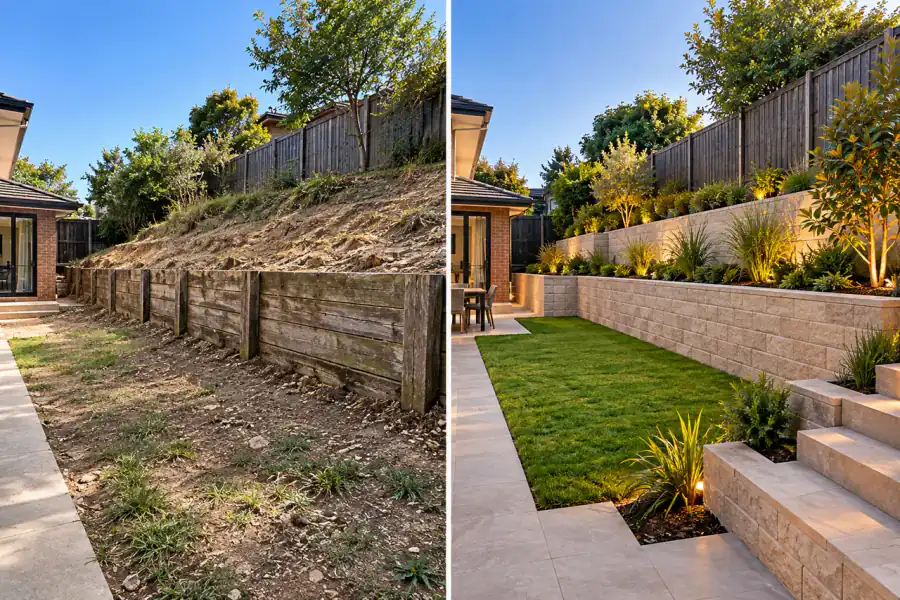
What pushes a job past these ranges: walls over one metre, engineering and permit fees, hand-only access, rock or tree roots during digging, steps built into the wall, and turf or planting afterwards.
Timber vs Concrete Sleepers: Which Is Better Value?
| Treated pine | Concrete sleeper | |
|---|---|---|
| Upfront cost | Lower | Higher |
| Lifespan | Shorter | Longer |
| Moisture and termites | Can rot over time | Not affected |
| Look | Natural timber | Range of colours and textures |
| Best for | Low garden walls, tight budgets | Boundaries, raised lawns, damp sites |
Timber is cheaper upfront, but it eventually rots, especially in wet clay. Concrete sleepers cost more at the start but often work out cheaper over the life of the wall.
What Should a Retaining Wall Quote Include?
- Wall length, height and material
- Excavation and removal of soil
- Footings, posts or reinforcement
- Drainage pipe, gravel, filter fabric and the outlet
- Backfilling and compaction
- Removal of any old wall
- Engineering and permit responsibilities
- Steps, capping or finishing work
- Clean-up and waste removal
- What’s not included
If one quote is much cheaper than the others, check whether drainage, engineering or waste removal are missing.
How to Keep Retaining Wall Costs Down
- Keep walls under one metre where you can. Two lower terraced walls can sometimes avoid the engineering and permit costs of one tall wall.
- Choose the right material for the job, not just the cheapest. A wall you have to replace in a few years isn’t a saving.
- Combine works. Building the wall at the same time as paving, turf or wider landscape construction shares machinery and setup costs.
- Clear access in advance. Removing obstacles from side paths and driveways saves labour time.
- Never skip drainage. It’s a small part of the cost and the main reason walls fail.
Common Retaining Wall Cost Questions
Both are used. Per lineal metre is common for walls of a standard height. Per square metre (length × height) is more useful when comparing walls of different heights, because it accounts for the extra material in a taller wall.
Do retaining wall prices include GST?
The ranges on this page include GST. When comparing quotes, check whether each one is quoted with or without GST.
Should the retaining wall be built before other landscaping?
Yes. Walls, excavation and drainage should be finished before paving, turf and planting go in, so the finished garden isn’t disturbed or damaged later.
Who pays for a retaining wall on a boundary?
It often depends on who changed the ground levels and why. Boundary walls can affect both neighbours, so get advice and agree on responsibility in writing before work starts.
Get a Retaining Wall Quote in Melbourne
The only way to get a reliable price is to have the site inspected. TXR Landscaping Contractors assesses slope, soil, drainage, access and nearby structures before quoting, and provides a clear written quote with agreed inclusions. We carry $10 million public liability insurance and are available 7 days, 8am–5pm.
Related cost guides: Landscaping costs · Paving costs · Turf installation costs · Backyard landscaping costs